The UAE company will establish two energy storage stations: the Banban Station with a capacity of 500 MWh, and the Zafarana Station with a capacity of 1,000 MWh.
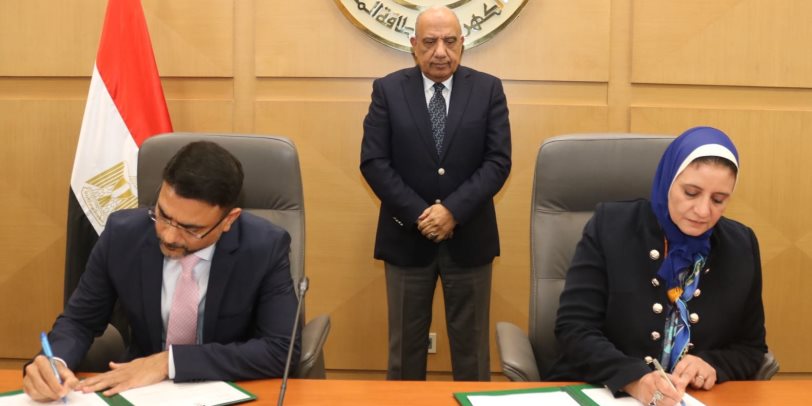
The Egyptian Electricity Transmission Company ) EETC ) has signed an agreement with the UAE-based AMEA POWER to implement a project for constructing two independent battery energy storage stations with a total capacity of up to 1,500 MWh.
The UAE company will establish two energy storage stations: the Banban Station with a capacity of 500 MWh, and the Zafarana Station with a capacity of 1,000 MWh.
In addition, transformer stations will be constructed and connected to the unified power grid to increase the share of renewable energy in the daily energy mix and enhance the state's efforts toward sustainable development.
Mahmoud Esmat, Minister of Electricity and Renewable Energy, emphasized that independent energy storage using batteries is a key component of the state's vision and the Ministry of Electricity and Renewable Energy’s plan to maximize the benefits of renewable energy sources.
He explained that the project will enable the discharge of stored energy during peak periods, contributing to the stability of the unified grid as large capacities of solar and wind energy are introduced.
The locations for the stations were chosen in coordination with the New and Renewable Energy Development and Utilization Authority and the Egyptian Electricity Transmission Company, in line with the state's strategy to develop the renewable energy sector, maximize the use of natural resources, reduce fossil fuel consumption, and lower carbon emissions.
The minister also noted that this project is part of the ongoing partnership with the UAE-based AMEA POWER, a leader in the renewable energy field.
He highlighted Egypt's goal of increasing the contribution of renewable energy to 42 percent of total generated energy by 2030 and 65 percent by 2040, according to the National Energy Strategy approved by the Cabinet.